Showing posts with label PSOE. Show all posts

Thursday, 21 February 2008

The official campaign starts!


The campaign is officially on. Zapatero from Madrid and Rajoy from Cadiz kicked off their presidential campaigns.

The economic debate tonight gave me a big boost of optimism, Solbes destroyed Pizarro with voter-friendly language, visuals and tough attacks on the conservative agenda. Certainly Pizarro's proposal to scrap the current housing policy really hurts PP with young voters and women.

I also just got a letter from the head of the Socialist Congressional list for Murcia, my constituency, asking for my vote.

PSOE has also put out a very interesting campaign. Its PEB asks for people to go vote (abstention hurts us) at any cost. But the video shows a Socialist young voter going to pick up his mum in the village to take her to the polling booth even if he know she's going to vote PP. Nice positive message, will it work? I think so, bold nevertheless.

Saturday, 16 February 2008

New poll and BIG warning

The most prestigious poll in Spain, CIS, has given PSOE an advantage of just 1.5 points over PP in voting intention for the March 9 election.

Although Zapatero's personal numbers are high and Rajoy's are pathetically low, conservative PP keeps closing the gap as election day draws closer. The official campaign hasn't started yet, we haven't had debates yet, but PP's campaign is light years ahead of PSOE's, and that is worrying me a lot more than our programme being far ahead of theirs.

Noone debates the fact that this election is crucial, for us is about further modernisation both social and economic, for PP is about rolling back social liberalism and getting back their caciquist control of the economy.

Today however we saw how things can change and PSOE can hit back at PP. Felipe Gonzalez, former President from 1982 to 1996, has shown the way and PSOE leadership should follow his line. He stood up in a podium in Barcelona and bashed every single PP leader hard, where it hurts. Stop the nice-guy campaigning, it has failed us and can make us lose the election. If they are nasty so can we be. Spain is definitely left-leaning that's why PSOE has a comparative electoral advantage, conservatives know it as well and they have gone negative. They are gaining ground day by day, their noise neutralises our message. We need to hit back and we need to do it soon. Maybe Gonzalez should join the electoral team, he's the best and most experience campainger this party has and we need him now. There's a reason why he won four elections in a row. Time to wake up, the CIS poll this week has given as a warning next one could be too late.

Zapatero gathers support in Europe.

Zapatero's reelection bid has now got a website to gather support from fellow Europeans.

You can find the website here

Two Nobel Prize winners, Gunter Grass and Jose Saramago, have already joint the platform's manifesto.

Friday, 8 February 2008

Day and night of political endorsements.


Zapatero has today recived the public support of the independent National Research Council and soon there will be a manifesto endorsing him from the scientific community called 'Science and University with Zapatero'.

Rajoy has received the support of the Spanish Catholic Church.
No need to go any further. 21st century Europe, which party you think is better prepared to keep the country on its modernising path? Science or religion?

Monday, 4 February 2008

New PSOE video out.

PSOE has put out a new PPB this week. I think the idea is great, exposing PP's negativity. However I think the video could have been a bit tougher...still great video to contrast two very different visions, aspiration versus catastrophism.

Have a look,

Wednesday, 23 January 2008

PSOE's Political Conference this weekend.


For those of you interested, PSOE's political conference is ready to go this weekend (26-27th January 2008).

The conference is organised for militants and party officials to get together and debate ideas and proposals for the electoral manifesto as well as to prepare the party and its base for the battle ahead.

Us, bloggers, have been invited by the party to participate in the conference, unfortunately my trip from London is a bit too expensive for PSOE to pay (perfectly understandable, the funds will be put to better use during the campaign), but I am grateful for the invitation nevertheless.

Key speeches and events will be available however through PSOE's online TV, so if you speak Spanish and feel like knowing how PSOE's internal democracy works then you can do it there.

For those of you who don't speak Spanish, don't worry, I'll be blogging the conference from London giving you all the details and gossip.

So come around here on the weekend, the international experts as well as party officials and grassroot activits will be down in Madrid and it's definitely going to be big!

Friday, 11 January 2008

New Socialist Youth video.

I just watched this new electoral video by the Socialist Youth and I cannot agree more with its arguments. The night of the 14th of March 2004 thousands of young people celebrating PSOE's victory then chanted to Zapatero the now famous slogan 'No nos falles' ('Don't fail us' in Spanish). That chanting represented the trust millions of young voters had given Zapatero through their vote.

This video, though in Spanish, shows why the Zapatero Presidency has done more than any other before for the young members of society. For all of those of you that understand Spanish here you are.

A good day for Zapatero.

After a couple of weeks of a good news cycles for PP yesterday PSOE grabbed the initiative again.

In the morning it was Rajoy who made a fool of himself by announcing that if elected he will create a new ministry of the family and social welfare. This announcement was aimed at capitalising on the Church's rally a week ago in favour of the 'traditional' idea of the family, that of a man and a woman. I surfed around different blogs and comment sections of newspapers and other media outlets to find out the reaction to this 'unusual' announcement. It was unanimous, every single comment, besides of those coming from the less sane citizens of Spain, either joked about the proposal or felt it was outright populist. Furthermore, many requested to know what would then happen with the already established Social Affairs Ministry. A legitimate question I would say, specially if the creation of new and innecessary bureaucracy comes from a self-appointed economic liberal that is giving away tax cuts as if they were sweets. And they say PSOE can't handle the economy, wait for Mr. morality to come in with a blank cheque for the religious right.

The second and most important announcement of the day came from France. The first Sarkozy-Zapatero bilateral summit ended with the announcement of the creation of a new permanent police command formed by French and Spanish forces to cooperate in the fight against ETA's terrorism. ETA has been by far the least popular issue for the Government in the last four years. PP's disloyal opposition to the peace process became the first time in the democratic history of Spain that a party used the fight against terrorism for electoral purposes. But that opposition of simplistic arguments and outright lies have hurt the Government specially after the failure of the cease fire. This new announcement shows that Zapatero gave peace a chance but didn't disregard police action as essential in the fight against ETA. This new agreement with France is by far the most important in the history of the conflict since Mitterrand agreed to 'offer a helping hand' in the 1980s to Felipe Gonzalez. PP officials were gutted, Sarkozy, a rightwing populist like them had just blown one of their key issues for the campaign. Sarkozy's decission together with the rejection today by Congress of PP's proposal for a debate on Batasuna's legal status, political wing of ETA, before its dissolution have further weakened the terrorist front in the campaign.

So things are looking up. I argued on Sunday that PSOE has a good chance to win with an even greater majority on March 9. The economic debate will blow over because although it could be bad for PSOE, PP has got no economic team to compete with the Socialist one. The debate on the fight against terrorism is looking better by the day for PSOE and if the illegalisation of Batasuna's sister party, ANV, arrives before the election it will be even better for the Socialists. If PSOE can keep control of the news cycle until the campaign officially starts and then runs a serious and energetic campaign I believe everyone will be suprised of the end result. I still believe an absolute majority is possible for Zapatero.

Thursday, 3 January 2008

The Church enters the campaign.

On Sunday the governing hierarchy of the Spanish Catholic Church organised a mass rally in Madrid to denounce certain liberal policies promulgated by the Zapatero Government in the last four years.

Bishops from across Spain denounced the new divorce law, gay marriages and the new education plan as well as the 1985 abortion legislation.

Such display of moralistic righteousness and social intolerance is common among the Catholic hierarchy in Spain. But this time around their claims went even further and entered the very political. They denounced the rolling back of Human Rights and the possible dissolution of democracy because of these laws and openly attacked the Zapatero Government.

This is the last step taken by PP and his right-wing apparatus to poison even further the political situation in the country. Couple of months ago I wrote in this blog that PSOE wasn't planning to present in his electoral manifesto any issues that could be seen by the Catholic hierarchy as a head on attack on them. I called for PSOE to rethink their position, and I think the bishops' show on Sunday proves my argument right. The Spanish Catholic Church is certainly one of the most conservative and anachronistic ones that exist today. Having openly supported the Francoist dictatorship, they still enjoy fiscal and legal benefits unknown anywhere else. Today I ask myself why should my taxes be paying this church to spread hatred and intolerance as well as openly oppose my political believes? A revision of the State-Church agreements must now be undertaken and it's the Catholic Church that has forced such revision. Their faith is in decline not because of a Socialist Government but because of their fundamentalist views on social issues that Spaniards dealt morally with a long time ago.

Furthermore, I second Jose Blanco's, PSOE's secretary of organisation, demand that if PP is in full agreement with the Catholic hiearchy that they present in their electoral manifesto a promise to derogate the following laws, denounced by the bishops: gay marriage and adoption, equality, abortion and education. I can assure you they won't do it, because they know the Spanish public in general supports them. They let the Catholic Church do the dirty job for them, if that it isn't cowardice you let me know a better definition for it.

Monday, 24 December 2007

PSOE and Catalonia

El Pais newspaper has produced a leaked memo from PSOE HQ advising their Catalan section, Partit dels Socialistes de Catalunya (PSC), to promote a more Catalanist discourse in the run up to the March election. The reason for this is, as mentioned many times before in this blog, that Catalonia is key for PSOE to win the election. In the 2004 election, PSOE won from Catalonia 21 seats in Congress against 6 by PP. PSOE strategists however are worried about the more nationalist vote within Catalonia that might be going to nationalist parties or abstain this time around after the infrastructure crisis in Barcelona and the delay on the arrival of the high-speed train line from Madrid.

PSOE's support in Catalonia is divided between two groups. Firstly, immigrants from other parts of Spain that moved to industrialised Catalonia and share a dual identity, both Spanish and Catalan, and which tend to go vote and represent around 70% of PSOE's share in the region. The second group is that of Catalan-born middle-classes with a strong Catalan identity that tend to vote nationalist in regional and local elections but vote PSOE in general elections as they see the party friendlier to their interets. This second group represents around 20-22% of PSOE's vote but is more volatile, as it tends to abstain more often.

This second group is the one PSOE strategists are worried about. The infrastructure crisis hits them harder than any other group, as business people, and feel that a nationalist party in a coalition government could bring in the extra investment to sort ou the situation in Catalonia. A more Catalanist discourse by the newly chosen head of list, the current housing minister, Carme Chacon, could reactivate their vote.

Although PSOE's vote loss isn't going to go to PP, it would mean a smaller number of seats to add up to the national count. PP is gearing up to fight hard in Valencia and Madrid where the biggest number of seats for them are going to come from. PSOE is focusing in Catalonia, as Andalucia, its other key stronghold, is very active politically and will carry a big majority for them.

The only problem is the leak comes from those within the party that feel PSOE is pandering to peripheral nationalists rather than focusing on a more 'Spanish' vote. Although unlikely, this can also add up to the growing concern of moderate voters from poorer regions, that feel alienated while Catalonia gets bigger chunks of the budget for public investment.

Friday, 7 December 2007

Media wars.


People that follow closely media developments in Spain might be noticing a slight change of attitude towards the Government by El Pais newspaper in the last few months. Several op-eds and reports lately are starting to be more critical than usual of the Zapatero Government. The reason for this is called La Sexta, the new TV channel in Spain and a new media group growing around it.

PRISA media group, biggest in the Spanish-speaking world and owner of El Pais, has been the sole supporter of Socialist governments in Spain for a long time against the army of right-wing media groups supporting PP. PRISA furthermore, owns the most influential media outlets in the country, Cadena Ser (radio), El Pais (newspaper) and Digital + (digital TV). Are they the most influential because Spaniards are more left-leaning and therefore prefer PRISA outlets? or is it because of the quality of their content? Whatever your opinion is noone can deny the inmense blow that losing PRISA's support would mean to PSOE's ability to get its message out to the public. So the question I present to you here is... what's going on with PRISA and PSOE?

In March 2006 La Sexta a new left-leaning channel appeared in Spain. It was given a public license strongly supported by Zapatero as a new media group able to diversify the media ideological spectrum in Spain. Zapatero wanted to have both PRISA and La Sexta on his side to be able to counterbalance the information attacks from the right-wing media more numerous in Spain. But obviously PRISA wasn't happy to see their monopoly of the left-wing audience shared with a new outlet. PRISA however it is known for producing very rigorous information and analysis and their international prestige was also at stake. They decided to wait and see the development of the new channel. In 2007, after their success with the emission of the football World Cup and the basketball World Cup (that saw Spain win their first ever world title bringing in massive audiences) La Sexta also acquired partial emission rights for the national football tournament, La Liga. PRISA started getting worried because their new open channel, Cuatro, wasn't performing as expected and was directly competing with La Sexta in terms of audience ratings. It was at this point that Zapatero decided to push further to consolidate the new channel as the vanguard of a new media group to develop from it. When the new Minister for Justice was appointed in February 2007 Zapatero decided to give the exclusive to La Sexta breaking a long tradition of giving it to PRISA outlets first. This action shook the foundation of the special relationship PSOE-PRISA. The final development in this process has been the court case being fought between La Sexta and PRISA over which La Liga matches can be shown by whom every weekend according to their respective TV rights, also known as the football war.

The shaken relationship between PRISA and PSOE is founded in one single development. PRISA has seen its business interests challenged by La Sexta with now means greater competition for an all-powerful media group. The fact that Zapatero hasn't been as friendly to PRISA as other PSOE leaders before has spread paranoia across PRISA that has decided to flex its muscles to get back their advantageous position.

PRISA is a very prestigious organisation, known for the quality of their content and analysis, able to draw in the most influential minds to contribute to its outlets. PRISA is no News Corp. and the late Jesus de Polanco no Rupert Murdoch. PRISA will stick to its left-leaning tradition in the future because they consider PP a total no-go option (especially after Rajoy decided to boycott the media group after a comment by Polanco criticising PP's attitude in Congress). Furthermore La Sexta isn't even close to be a serious contender to their power over Spanish public opinion today, at least not yet. But PSOE should be worried about pissing them off too much. They haven't damage PSOE that much yet, but they definitely could. Although I believe the relationship between both sides is honest and one of respect, PSOE got more to lose of an open war than PRISA does. Promoting La Sexta is a good strategic move to counterbalance the outrageous bias by the right-wing media in Spain controlled by both PP and the Catholic Church. But shouldn't be incompatible to keeping the special relationship with PRISA that's been so helpful so far.

Sunday, 2 December 2007

Llamazares elected IU candidate for March election.


As it was expected, Gaspar Llamazares, Secretary General of IU (United Left), has won the nomination to the Presidency of Spain in the March general election. The party's Federal Political Council nominated him today wiht 84 votes in favour and 2 abstentions.

This is good news both for the Left in Spain as well as for the country as a whole. Llamazares, unlike his predecessor Julio Anguita, is a serious statesman with a coherent vision of how politics should be carried out.

Llamazares understands that IU isn't anymore a party aiming to win elections but rather to influence governments from the opposition. As I mentioned in my piece yesterday on electoral behaviour in Spain, IU's most useful weapon is its ability to take power away from PSOE. Anguita, in the 1990s, disgracefuly joined Aznar in his demagogic attacks against President Gonzalez. Anguita was used by Aznar as a pawn in his strategy of creating a united Left-Right front against PSOE and succeeded at it. Anguita saw himself praised in the right-wing press and with his messianic attitude towards politics always believed he was pushing himself all the way to the Presidency. He never realised how much Aznar despised IU and after he won the 1996 election Anguita was quietly brushed aside and disappeared from the political scene.
Llamazares was elected as Secretary General of IU after PP's second electoral victory in 2000. He redefined IU's political strategy by putting as his first aim a left-wing government. He believed that IU would be more influential with a PSOE government than with a PP government even if IU's share of the vote went down. He has put IU back as PSOE's natural ally in Parliament and proven his ability to have his voice heard by the Zapatero government in this last term. He has also been able to get IU back into powerful coalition governments in Catalonia and the Basque Country.
With Llamazares in charge at IU I know both IU and PSOE are better off in March.
In his nomination acceptance speech he has hinted towards political consensus and higher particiation in the political sphere. Something this author and many other Spaniards welcome in times when such consensus among the Left is more needed than ever.

Saturday, 1 December 2007

Electoral behaviour in Spain- an analysis (I)

Left-wing parties across the globe have been undertaking in the last two decades what has been called ‘the journey to the centre’. Electoral behaviour theory tells us that a party has to conquer the ideological centre to win elections and power.

Cesar Molina founder of Multa Paucis, a Spanish public affairs consultancy, tell us this phenomenon is different in Spain. Here are the arguments:

Since the first democratic elections in Spain, the Left has always had between 2.3 and 3.5 million more votes than the Right. Only in the 2000 general election, won by PP with absolute majority, did the Right win more votes, 1 million more than the Left. The Left lost 2.7 million votes in comparison with the 1996 election. However of those 2.7 millions only 0.6 millions went to the Right, the remaining 2 millions simply abstained (the abstention rate in 2000 was the highest in history, 69%). This, Molina argues, shows that the real centrist voter accounts only for around 0.6 million people in Spain while the 2 millions are traditional left-wing voters that tend to abstain in certain circumstances. This atypical electoral behaviour has a precedent in history. In 1933, abstentionism by left-wing groups, anarchists in this case, gave the Right a victory while in 1936 that same group when to vote and the Left won the election.

In general terms this means that PSOE, the biggest left-wing party, always has a clear advantage to win general elections. However, the challenge for the party lies in that while the right-wing vote always goes to PP, the left-wing one is generally shared by PSOE and IU (United Left). Statistical analysis shows that for every 1% increase in voting PSOE benefits of 0.6% of that vote. But at the same time for every 1% of the vote that IU gets PSOE’s share goes down 1%. On the other hand the same analysis shows that electoral participation swings do not affect PP’s share of the vote. In other words, PP voters always vote while left-wing voters don’t always vote and they split their vote between two parties.
What are the conclusions according to Molina for the March 2008 general election? That if participation falls below 71% (in 2004 was 76%) and IU keeps their 4% share of the vote the election will be too closed to call. If IU’s share of the vote would go up to 6% PSOE would need a 74% participation to win.
This same analysis can be used to analyse the impact of the Catalan vote in March. After a series of transport and institutional crises in Catalonia, a fear of high abstentionism in the region is worrying PSOE strategists. If the vote in Catalonia falls below 64% (lowest in history in 2000) then PSOE would lose between 3 or 4 seats in Congress and would need a participation of 73% in the rest of the country to keep power.
The conclusion is that PSOE has a greater chance to win the election in March. However it is essential that it is able to mobilise the left-wing vote. The abstentionist left-wing vote stands ideologically more to the left than PSOE. However that same vote would rather see PSOE in power than PP hence why they vote for it when elections are too close. If PSOE is able to convince these voters of the crucial role they get to play this time around victory will be pretty safe in March.
What is PP doing to encourage the left-wing vote to stay at home? That is the content of my next piece.

P.S: This analysis fails to take into account the particularities of Spanish electoral law but I believe Molina rightly analyses the big picture which is very useful to understand electoral behaviour in Spain and its particularities compare to other Western democracies.

Thursday, 29 November 2007

Bono accepts to be candidate for Toledo.


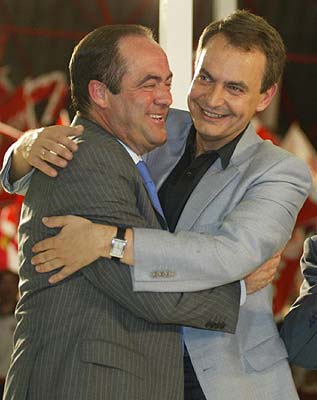
Jose Bono, former President of Castilla la Mancha and Defense Minister, has accepted Zapatero's offer to head the list for Toledo in the general election and to be the next President of Congress if PSOE finally wins the election.

This is great news for PSOE. Bono is considered a moderate within the party. He has always been a bridge between PSOE and right-wing voters and this time around it won't be different. He's inclusion in the party list will give a great boost to the party with moderates and Catholics as well as those in the left that are less friendly towards peripheral nationalisms.

With Bono, a self-proclaimed 'left-wing Catholic Spanish patriot', and Pedro Solbes, Economics Minster and former EU Commissioner, PSOE strategists are aiming to counterbalance the image the right-wing media is given of a radicalised party. Both high-profile candidates are well respected across the political spectrum and will help round up important centrist voters that previously could have stayed at home or even have voted PP.

Zapatero has shown a great strategic ability to hit PP where it hurts, their lack of moderation and cross-party appeal. Where are the moderates within PP? They all have been bullied into submission, only Calomarde spoke out and was forced to leave the party. That taught others like Celia Villalobos and Ruiz Gallardon a lesson, moderation isn't in PP's vocabulary.

The power of the Catholic Church.

So the PSOE electoral manifesto is not going to include this time around any mention to abortion, euthanasia or the State-Catholic Church Pact of 1979.

I can understand the reasoning behind this decission, though not share it. The continuous attacks by the Catholic Church and the bishops' radio station, COPE, against the Government have fuelled protests by PP voters and right-wing groups. Gay marriages and adoption as well as the non-sense attack against the new subject in primary education 'citizens' education' have proven difficult rides for PSOE during this term and taken away the support of Catholic working class groups.

The decission is oriented to prevent the Church to become an active part of the electoral campaign by rallying its 'troops' and hurting PSOE with the Catholic vote in key areas like the Basque Country and Andalucia. However I believe it is time to take the Catholic Church on and prove to them that Spanish people are ready to remove the few privileges they still enjoy rooted in Franco's legacy.

The Catholic Church still has the right to provide a Catholic education subject in public schools, with an alternative provided for non-religious students, and benefits from limited Government funding payed by all taxpayers, including non-Catholics. PSOE has to show the strength needed to remove these privileges and remove all relations between the State and the Church, only this way we will be able to remove their ability to exert such a demagogic influence in the political arena. It is public money which is funding the Church's activities which do not anymore concern helping the needed but rather to consistently attack the left in perfect harmony with PP. Until we do not bang the fist on the table the 'Catholic electoral problem' for PSOE will never go away.
It will be hard but PSOE is the only party able to finalise what was started in 1979, the complete separation between Church and State in Spain.
The decission to duck the problem is not just ideologically wrong it is also electorally wrong because the problem will come back in 2012 while I have to keep paying taxes for the bishops for another 4 years.

Wednesday, 28 November 2007

Zapatero seven points ahead in the polls.


Spain's biggest radio station has given PSOE a seven points difference over PP in their weekly 'Pulsometro' poll.
PSOE gains half a point from last week's poll to a total of 45% of the decided vote. PP's share of the decided vote stays unchanged on 38%.
According to the same poll, Zapatero's popularity is gone up to 5,24 points while Rajoy's is gone down to 3.9 points, one of its lowest since the 2004 elections.

This is all good news for PSOE especially after the last few weeks when the commuter train system in Catalonia was severly disrupted and its regional Parliament called for the sacking of the Minister for Transport. Catalonia being ,together with Andalucia, a crucial stronghold where PSOE has to mobilise its vote to win.
There are fears within Ferraz (PSOE HQ) that clear majorities in polling and continuing disruptions in key electoral constituencies could discourage the PSOE electorate to come out to vote. They are right, it is time to highlight the crucial times Spain is living and mobilise the left-wing vote across the country.

Tuesday, 27 November 2007

Three Nobel Prizes will help draft the electoral manifesto.

Jesus Caldera the Minister for Employment and Social Affairs and the person in charge of drafting the electoral manifesto for PSOE has announced a new team of high-profile advisors for the campaign:

  1. Joseph Stiglitz.- Economics Nobel Prize Winner in 2001 and former Chief Economist and Vice-President of the World Bank.
  2. Wangari Maathai.- Peace Nobel Prize Winner in 2004, founder of the Green Belt Movement in Kenya and environmental activist.
  3. Helen Caldicott.- Peace Nobel Prize Winner in 1985 for her campaigning on nuclear disarmament
  4. Nicholas Stern.- Former Chief Economist and Vice-President of the World Bank, present holder of the IG Patel Chair at the London School of Economics and author of the widely-praised Stern Review on the economic cost of climate change.
  5. Torben Iversen.- Harold Hitchings Burbank Professor of Political Economy at Harvard University.
  6. Jeremy Rifkin.- Founder and president of the Foundation on Economic Trends in the US.
  7. Maria Joao Rodriguez.- Portuguese Economics Professor.
  8. Barbara Probst-Solomon.- US writer and columinst.
  9. Philip Pettit.- Irish philosopher and political scientist.
  10. Andre Sapir.- Brussels-based economist and expert in European convergence and globalisation.
  11. Marie Duru-Bellat.- Sociologist and Education Sciences specialist at the University of Rennes (France) and former adviser to French presidential candidate Segolene Royal.
  12. Guillermo O'Donnell.- Hellen Kellog Professor of Government at Notre Dame University (US) and prominent theorist on democratisation theory in Latin America.
  13. George Lakoff.- Linguistics Professor at the University of California Berkeley.
  14. Wolfgang Merkel.- Professor of political sciences at the University of Heidelberg.
The announcement produces a double effect for PSOE. Firstly, it will help draft a strong and coherent manifesto for 2008 as well as future government policy. And secondly, it shows the appeal Zapatero's government has among progressists across the globe.

You might ask yourself, who is willing to volunteer for PP's electoral team? Well, the answer is no-one. Its electoral team tried to spin this failure to attract any international adviser by putting out a PPB claiming their team is made of common Spanish people with everyday problems...well, moving, but shows PP's lack of appeal both nationally and internationally.